
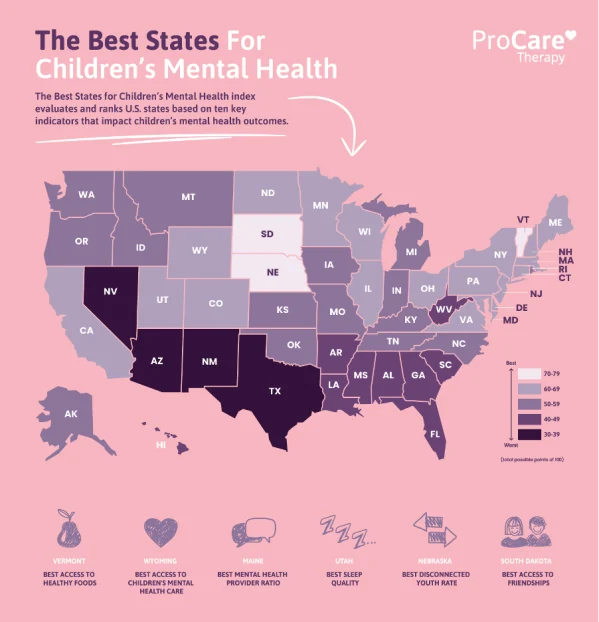
Where a child grows up plays a massive role in shaping their mental well-being—not just in the present but for years to come. Some states have made children’s mental health a top priority, offering funding, education, and programs that set kids up for success. So, which states are doing it best? That’s exactly what ProCare Therapy set out to discover.
While scraped knees and playground squabbles are inevitable, what shouldn’t be is a child struggling with their mental health simply because of where they live.
Where a child grows up plays a massive role in shaping their mental well-being—not just in the present but for years to come. The environment they experience, the support they receive, and the resources available to them all contribute to how they handle stress, develop resilience, and navigate the challenges of life. Some states have made children’s mental health a top priority, offering funding, education, and programs that set kids up for success.
So, which states are doing it best? Which ones are ensuring kids have not just a happy childhood but also a solid mental health foundation that will carry them into adulthood? That’s exactly what ProCare Therapy set out to discover.
About the Index
The Best States for Children’s Mental Health index aims to evaluate and rank all 50 U.S. states based on ten key indicators that impact children’s mental health outcomes, such as timely and sufficient access to services as well as geographical and socioeconomic conditions that contribute to or detract from children’s mental health. It uses the most recent versions of reputable, publicly available datasets from sources such as the U.S. Centers for Disease Control and Prevention (CDC) and the U.S. Department of Education (ED).
The indicators utilized in the index and how each indicator influences children’s mental health include:
- School Counselor Staffing: School counselors provide critical emotional support, crisis intervention, and academic guidance for students. States with better counselor-to-student ratios are more likely to provide timely and individualized support.
- Mental Health Provider Ratio: More providers mean easier access to care. States with higher mental health workforce investments help reduce wait times and ensure children get the support they need.
- Timely Access to Children’s Mental Health Care: Delays in treatment can worsen mental health issues. States with sufficient staffing and staffing solutions offer shorter wait times to ensure children get timely care.
- School Psychologist Staffing: School psychologists help identify and address issues early, which is crucial in long-term mental health. States education systems that prioritize funding and staffing for school mental health professionals ensure more students have access to better care and intervention.
- Disconnected Youth Rate: Teens who are neither working nor in school are at an increased risk of violence, smoking, alcohol consumption, and drug use, and they are more likely to develop mental health issues. States with strong education programs, workforce initiatives, and social services help keep young people engaged and supported.
- Child Sleep Quality: Poor sleep increases anxiety and stress. States with policies that support family well-being, healthy school schedules, and pediatric healthcare access promote better sleep habits.
- Supportive Neighborhoods: Strong community ties improve mental health. States that invest in safe neighborhoods, social programs, and community-building initiatives create environments where children feel supported.
- Physical Activity: Regular physical activity reduces stress, anxiety, and symptoms of depression while improving overall mood and brain function. States with better access to parks, recreational programs, and school physical education encourage more active, mentally healthy children.
- Access to Friendships: Friendships play a crucial role in children’s self-esteem and emotional health. States where children find it easy to make friends may foster inclusive school environments and extracurricular opportunities that help children build strong social connections.
- Access to Healthy Foods: Nutrition impacts mood and brain function. States that address food deserts, support nutrition programs, and promote access to fresh food contribute to healthier childhood development.
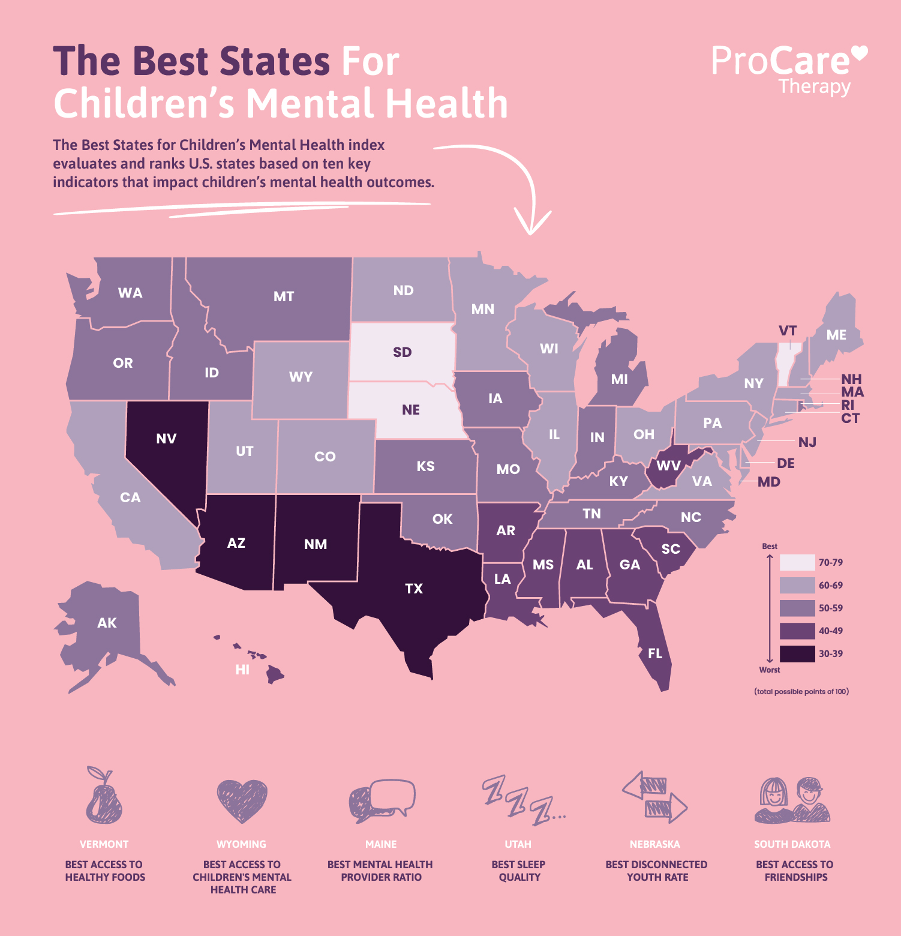
Mapped: How States Rank for Children’s Mental Health Support
Detailed Ranking
At the end of the day, every child deserves the chance to grow up in an environment that fosters confidence, resilience, and well-being. Dive into the detailed results of the Best States for Children’s Mental Health index below.
| Rank | State | Index Score |
| 1 | Vermont | 77.09 |
| 2 | Nebraska | 72.99 |
| 3 | South Dakota | 71.38 |
| 4 | Wyoming | 68.16 |
| 5 | New Hampshire | 68.11 |
| 6 | Connecticut | 68.10 |
| 7 | Utah | 67.43 |
| 8 | Maine | 67.21 |
| 9 | Wisconsin | 67.06 |
| 10 | Ohio | 66.73 |
| 11 | Illinois | 66.50 |
| 12 | Pennsylvania | 65.86 |
| 13 | Massachusetts | 65.84 |
| 14 | Maryland | 65.72 |
| 15 | Minnesota | 65.36 |
| 16 | Virginia | 64.19 |
| 17 | North Dakota | 64.12 |
| 18 | Colorado | 61.79 |
| 19 | Iowa | 61.33 |
| 20 | Delaware | 61.14 |
| 21 | California | 61.04 |
| 22 | New York | 60.18 |
| 23 | New Jersey | 60.05 |
| 24 | Montana | 59.91 |
| 25 | Rhode Island | 58.91 |
| 26 | Kansas | 58.87 |
| 27 | Alaska | 58.55 |
| 28 | Kentucky | 58.24 |
| 29 | Oregon | 58.15 |
| 30 | Michigan | 57.62 |
| 31 | Idaho | 57.18 |
| 32 | Washington | 56.13 |
| 33 | North Carolina | 56.09 |
| 34 | Missouri | 55.80 |
| 35 | Tennessee | 54.45 |
| 36 | Oklahoma | 52.37 |
| 37 | Indiana | 51.58 |
| 38 | West Virginia | 49.97 |
| 39 | Alabama | 49.33 |
| 40 | Georgia | 48.78 |
| 41 | Arkansas | 46.39 |
| 42 | South Carolina | 46.38 |
| 43 | Louisiana | 45.96 |
| 44 | Florida | 45.86 |
| 45 | Mississippi | 45.07 |
| 46 | Hawaii | 40.68 |
| 47 | New Mexico | 38.98 |
| 48 | Arizona | 38.18 |
| 49 | Texas | 37.63 |
| 50 | Nevada | 35.10 |
Raising Resilient Kids: The Top States Leading in Children’s Mental Health
- Vermont
Vermont tops the list as the #1 best state for supporting young minds. Explore the categories Vermont excels in below:
- Mental Health Provider Ratio: Ranks 5th, with 196 people for every mental health provider.
- School Psychologist Staffing: Ranks 2nd, with a ratio of 360 enrolled students per school psychologist.
- Disconnected Youth Rate: Ranks 7th, where only 5% of youths aged 16-19 are not in school or working.
- Child Sleep Quality: Ranks 8th, with 71.6% of children receiving the age-appropriate hours of sleep each night.
- Supportive Neighborhoods: Ranks 4th, with 66.8% of parents saying their child lives in a neighborhood where community members support each other and are there for one another.
- Physical Activity: Ranks 1st, where 62.3% of children meet the CDC’s recommended guidelines for children’s physical activity.
- Access to Healthy Foods: Ranks 2nd, with roughly 97% of the population who are low-income living close to a grocery store—which traditionally provides healthier options than convenience stores or smaller grocery stores and access to fresh fruits and vegetables
2. Nebraska
Nebraska comes in #2 for children’s mental health. Here’s where the state leads:
- Timely Access to Children’s Mental Health Care: Ranks 11th, where roughly 52.6% of parents say getting their child the mental health treatment or counseling needed was not difficult.
- Disconnected Youth Rate: Ranks 1st, where only 4.3% of youths aged 16-19 are not in school or working.
- Supportive Neighborhoods: Ranks 2nd, with 67.4% of parents saying their child lives in a neighborhood where community members support each other and are there for one another.
- Physical Activity: Ranks 10th, where 55% of children meet the CDC’s recommended guidelines for children’s physical activity.
- Access to Friendships: Ranks 11th, where 76.9% of children have no difficulty making or keeping friends.
3. South Dakota
South Dakota secures the #3 spot in the index by supporting children’s mental health in the following areas:
- Timely Access to Children’s Mental Health Care: Ranks 3rd, where roughly 56.4% of parents say getting their child the mental health treatment or counseling needed was not difficult.
- Supportive Neighborhoods: Ranks 5th, with 66.3% of parents saying their child lives in a neighborhood where community members support each other and are there for one another.
- Physical Activity: Ranks 6th, where 58.5% of children meet the CDC’s recommended guidelines for children’s physical activity.
- Access to Friendships: Ranks 7th, where 78% of children have no difficulty making or keeping friends.
How Geography Plays a Role in Mental Health
Mental health isn’t just about access to therapy—it’s about everything in an environment that influences a child’s emotional and psychological well-being. States that invest in early intervention programs, school counseling services, and mental health education give kids a head start in developing strong coping skills. Those with strong funding for special education services, community outreach programs, and parental support networks make sure no child falls through the cracks.
But it’s not just about what happens in the classroom. The places children call home—their neighborhoods, their access to nature, the safety of their communities—also shape their mental health. Children in areas with strong social services have better access to crucial resources, while those in states with higher healthcare accessibility can receive timely diagnoses and treatment for conditions like anxiety, depression, and ADHD.
Building a Brighter Future for Children’s Mental Health
When kids have access to mental health resources, live in supportive communities, and attend schools that prioritize well-being, they’re more likely to grow into confident, resilient adults. And as this report has shown, where a child grows up can make all the difference.
The best states for children’s mental health recognize that mental wellness isn’t just about treating issues as they arise but about creating environments—both at home and in school—that nurture emotional well-being from the start.
Of course, there’s always room for improvement. Even the high-ranking states can do more to ensure that every child, regardless of their background or zip code, has the mental health support they need. As awareness of childhood mental health continues to grow, so does the opportunity for real change. By expanding school-based programs, improving access to professional care, and addressing socioeconomic factors that impact mental health, states can ensure that every child—no matter where they live—has the foundation to flourish.
If you have a passion for supporting the mental well-being of the future leaders, innovators, and changemakers of tomorrow, we invite you to explore ProCare’s school therapy roles today and make an immediate impact on the lives of children.
Methodology
The Best States for Children’s Mental Health index aims to evaluate and rank U.S. states based on ten key indicators that impact children’s mental health outcomes, such as timely and sufficient access to services as well as geographical and socioeconomic conditions that contribute to or detract from children’s mental health. It uses the most recent versions of reputable, publicly available datasets from sources such as the U.S. Centers for Disease Control and Prevention (CDC) and the U.S. Department of Education (ED). Each indicator is scored and weighted equally (10%). The final score is calculated by multiplying each indicator’s normalized score by its weight, summing the results to rank states from best to worst.
The following indicators and data sources utilized in the index include:
- School Counselor Staffing: The adequacy of school counselor staffing based on 2024 supply and demand data. Data source: U.S. Department of Health and Human Services, Health Resources and Services Administration, Health Workforce Projections.
- Mental Health Provider Ratio: The ratio of population to mental health providers. Data source: Centers for Medicare & Medicaid Services (CMS) National Provider Identification Registry.
- Access to Children’s Mental Health Care: The percentage of respondents who say getting the mental health treatment or counseling that this child (age 3-17 years) needed was not difficult. Data source: National Survey of Children’s Health, Health Resources and Services Administration, Maternal and Child Health Bureau.
- School Psychologist Staffing: The average number of enrolled students in public elementary and secondary schools in fall 2023 for every employed school psychologist in May 2023. Data sources: U.S. Bureau of Labor Statistics; U.S. Department of Education, National Center for Education Statistics, Common Core of Data (CCD).
- Disconnected Youth Rate: The percentage of teens and young adults aged 16-19 who are neither working nor in school, therefore at an increased risk of violence, smoking, alcohol consumption and marijuana use, and may have emotional deficits and less cognitive and academic skills than their peers who are working and/or in school. Data source: U.S. Census Bureau American Community Survey (ACS), 5-year estimates.
- Child Sleep Quality: The percentage of children (age 3-17 years) receiving the recommended age-appropriate hours of sleep each night. Data source: National Survey of Children’s Health, Health Resources and Services Administration, Maternal and Child Health Bureau.
- Supportive Neighborhoods: The percentage of children living in neighborhoods where community members support one another. Data source: National Survey of Children’s Health, Health Resources and Services Administration, Maternal and Child Health Bureau.
- Physical Activity: The percentage of children aged 6-17 years who exercised, played a sport, or participated in physical activity for at least 60 minutes for at least four days during the past week. Data source: National Survey of Children’s Health, Health Resources and Services Administration, Maternal and Child Health Bureau.
- Access to Friendships: The percentage of respondents choosing “No Difficulty Making or Keeping Friends” in response to the question, “Compared to other children their age, how much difficulty does this child have making or keeping friends, age 6-17 years?” Data source: National Survey of Children’s Health, Health Resources and Services Administration, Maternal and Child Health Bureau.
- Access to Healthy Foods: The percentage of the population who are low-income and do live close to a grocery store, which traditionally provides healthier options than convenience stores or smaller grocery stores and access to fresh fruits and vegetables. Data source: USDA Food Environment Atlas.